
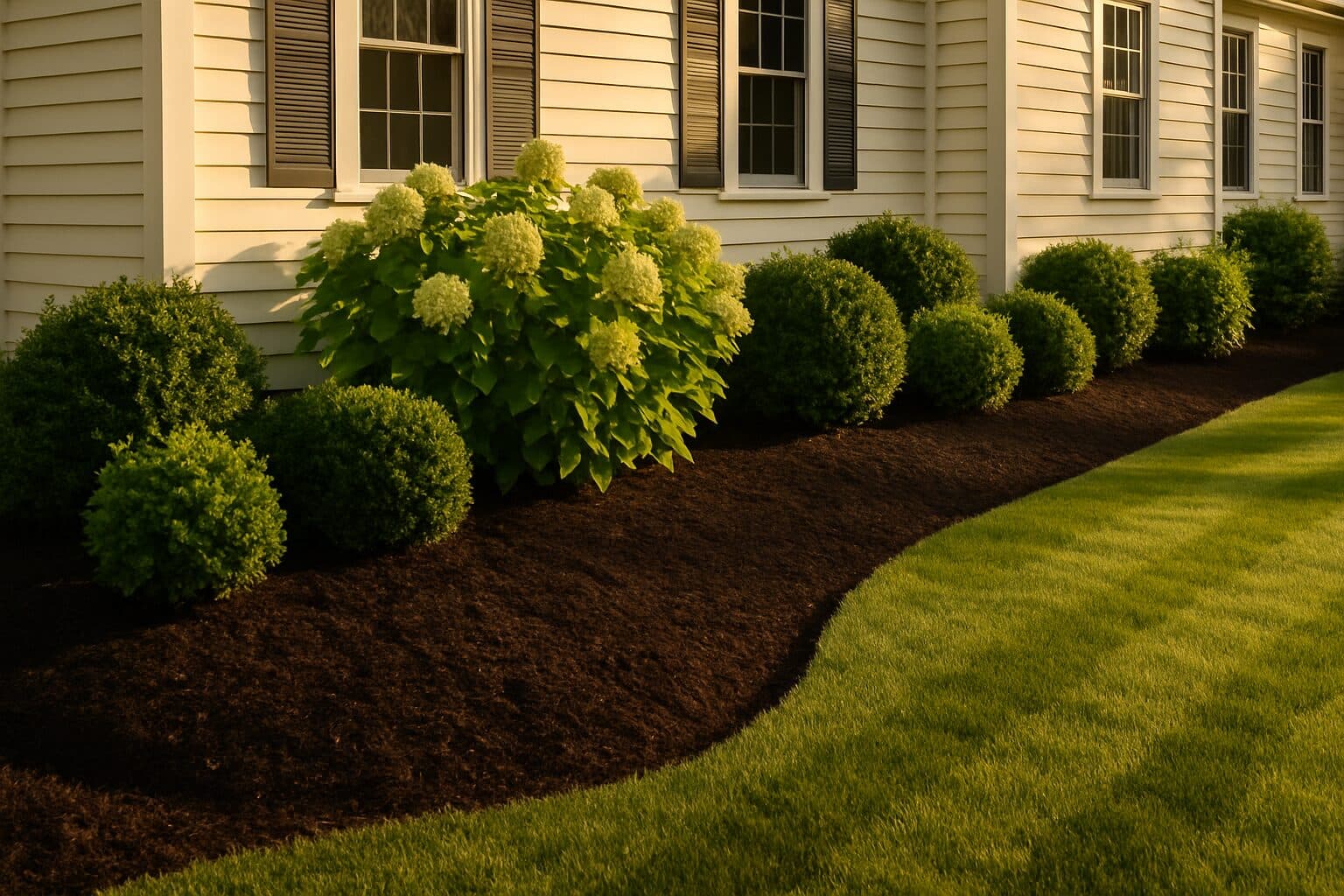
Salem's tight lots and historic properties call for careful, precise work — the kind that shows when you look up close.
Mulching in Salem, MA.
Fresh hardwood or cedar mulch in every bed at the right depth, with every edge re-cut by hand. Beds look new, weeds stay down, moisture stays in.
- Town
- Salem, MA
- Season
- Late April to mid-May
Overview
Mulching on the North Shore is typically done in late April to mid-May, after spring cleanup and before summer heat. Casey and Sons re-edges every bed, lays 2–3 inches of quality hardwood or cedar mulch (never dyed rubber or playground chip), and keeps mulch pulled back from plant stems and tree trunks to prevent rot. Done right, a single application lasts the full season and suppresses most weed germination.
What's included for Salem properties
- Re-edge every bed with a clean spade line
- Install 2–3 inches of premium hardwood or cedar mulch
- Pull mulch back from stems and trunks (no volcano mulching)
- Blow off walkways and hard surfaces after install
- Haul any excess off-site — no leftover pile in the driveway
Mulching in Salem
How mulching works on a Salem property
Mulching in Salem is a careful add. McIntire District beds are often historic-correct plant compositions — we add mulch in measured two-inch lifts rather than topping up to a fashionable depth that would smother established perennials. Chestnut Street properties usually want a darker hemlock blend. Coastal beds toward The Willows need lighter mulch volumes because salt-air drainage already keeps things drier; over-mulching there just locks in salt.
Local context
Landscaping in Salem — what makes it different
Salem is the most architecturally diverse town in our service area. Historic Federalist and Colonial Revival homes around McIntire Historic District and Chestnut Street demand a careful, unhurried approach — one-pass mowing, hand-trimming around stone walls, clean edge work that respects property lines measured in inches, not feet. North Salem and South Salem have their own character with more post-war single-family stock. Witchcraft Heights and the Willows combine historic and mid-century housing, each needing its own mowing cadence. Coastal proximity means salt-air plant selection matters for waterfront properties.
Neighborhoods we work in
- North Salem
- South Salem
- The Point
- Witchcraft Heights
- Downtown Salem
Local landmarks
- McIntire Historic District
- Chestnut Street
- Salem Common
- The Willows
- Witchcraft Heights
Questions
Frequently asked
When should mulch be installed?
Late April to mid-May is the window. Too early and the soil hasn't warmed; too late and summer weeds have already germinated under the old mulch.
What kind of mulch do you use?
Premium double-ground hardwood mulch (natural dark brown) is the default. Cedar is available on request — it lasts longer and smells better, but costs more. We don't install dyed red, dyed black, or rubber mulch; they do more harm than good.
How deep should mulch be?
2–3 inches on top of existing mulch, or 3 inches fresh on bare soil. Anything thicker suffocates roots and causes more problems than it solves.
Can you work on Salem's tight historic lots?
Yes, and that's a lot of what we do. Equipment access on streets like Chestnut or around McIntire District requires walk-behind mowers, hand tools, and patience with street parking. Crews that rush those properties end up damaging stone walls and edges.
Do you handle salt-air coastal properties in Salem?
Yes. Coastal-facing properties near The Willows and along the harbor need salt-tolerant plant selection, more careful mulch depth, and an eye on what's actually thriving vs. quietly stressed. We'll flag plants that aren't working and suggest swaps during the estimate.
Begin
A yard that stays on schedule.
Free on-site estimate. Typically same-day response. Every inquiry handled personally.